
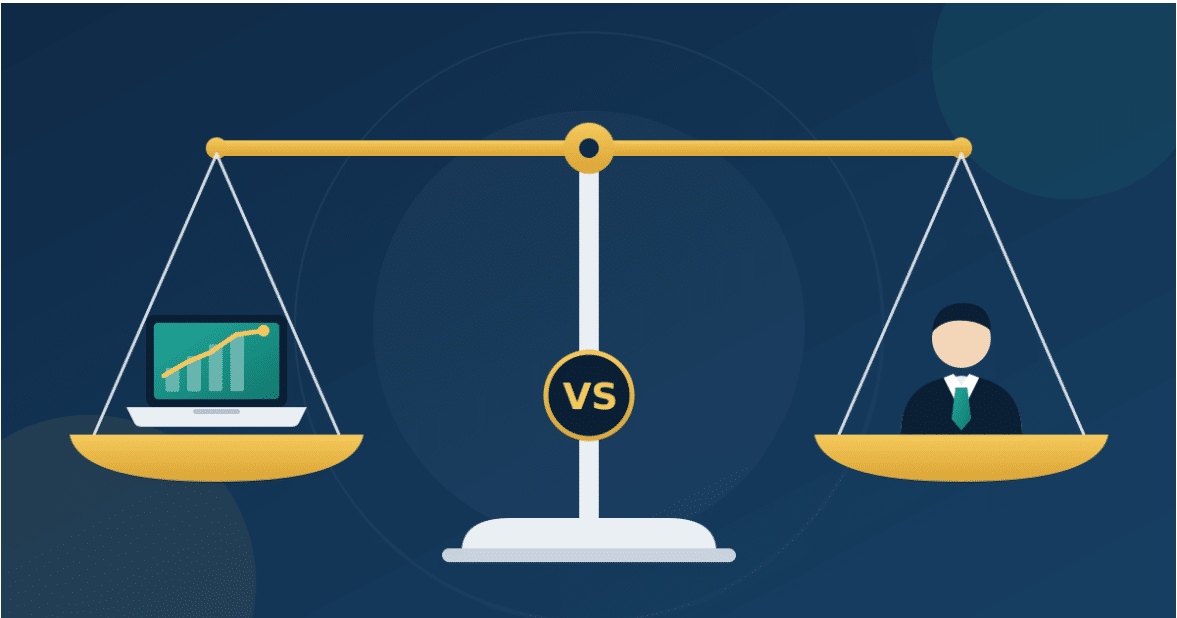
DIY Investing vs. A Financial Planner: What Each Really Costs You Over 25 Years
Are you wondering whether to hire a financial planner or DIY invest on your own? I hear this question all the time, and it’s personal for me right now, which I’ll explain below.
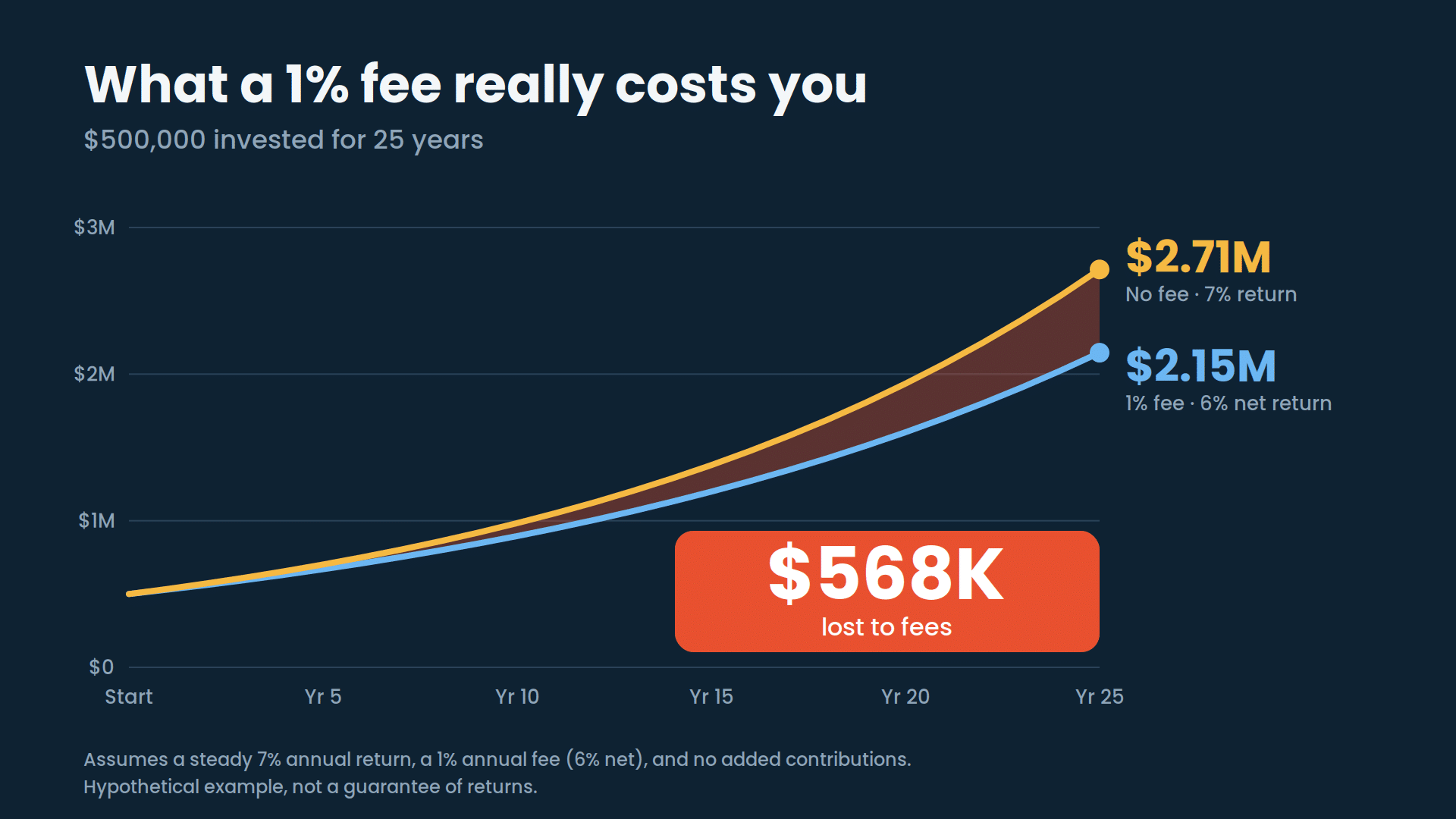
Start with the number that gets everyone’s attention: a 1% fee. The average financial advisor charges approximately one percent of assets under management. It sounds like nothing. But on a $500,000 portfolio, that’s $5,000 a year, and over 25 years it can cost you more than half a million dollars. And that’s assuming that your portfolio value remains constant!
This article may contain affiliate links which means that – at zero cost to you – I might earn a commission if you sign up or buy through the affiliate link.
Does that mean you should never hire a financial planner? Not exactly. Let’s break down who should DIY, who should hire help, and the middle option that most people overlook.
The Math: What a 1% Fee Really Costs
Say you invest $500,000 and earn 7% a year for 25 years.
- With no advisory fee, you end up with about $2.7 million.
- With a 1% fee, your return drops to about 6%, and you end up with about $2.1 million.
Same portfolio, same market. Roughly half a million dollars or more goes to fees.
The Case for DIY Investing
Self-directed, or DIY investing has a lot going for it.
Lower cost. A simple portfolio of low-cost index funds or ETFs can cost a fraction of a percent per year. A basic U.S. stock market index fund like Vanguard Morningstar Total Stock Market ETF (VTI) has an expense ratio of 0.03%, while an international stock ETF like Vanguard FTSE Developed Markets Index Fund ETF Shares (VEA) charges the same low rate. On a $100,000 investment, the annual expense ratio of 0.03% equals $30. No additional fees apply!
Full control. You decide what you own and when you change it. With a modicum of financial and investment education, you can learn how to to invest, and decide which investments fit your goals.
Simplicity. A basic three-fund portfolio of U.S. stocks, international stocks and bonds does the job. Since each ETF owns thousands of individual companies, three ETFs offer excellent diversification.
Solid performance. If you worry that a planner will deliver higher returns, that’s debatable. Plenty of data suggests index funds, which mirror the market, generally outperform most actively managed strategies.
Tax efficiency. Taxes also make a difference when investing. In a taxable investment brokerage account, trading can rack up short term gains, which might up your tax bill. Whereas, investing in index funds, which have minimal turnover, tends to keep taxable gains at bay.
The Case for a Financial Planner
A good planner is not just building your portfolio. You’re paying for something very different from asset management.
Behavior coaching. The biggest wealth killer isn’t necessarily fees. It’s panic selling in a crash. When investments drop, many of us get scared and sell. Then comes the bigger problem: we don’t know when to get back in. If you sell during a crash, you have to be right twice, once on the way out and once on the way back in. A planner can be a bit like a counselor for your money during those times.
Complex situations. If you have millions of dollars, stock options, business income, retirement withdrawals, Social Security timing decisions or estate planning needs, DIY gets riskier. Strategies like Roth conversions, tax-loss harvesting and asset location can save real money when done right. Some of you can handle these decisions by yourselves, but many don’t have the interest or the expertise.
If you need help with your investments, we’ve partnered with WiserAdvisor to provide you with access to three vetted Financial Advisors – in your area. Click the image below to sign up. (no obligation when signing up)

Peace of mind. Some people simply don’t want to think about it. If having someone take charge of your money is worth whatever it costs, that’s a legitimate choice.
If you decide to hire a financial advisor, make sure that he or she is a fiduciary, bound to put your needs first.
The Middle Option (Between DIY and Financial Planner) Most People Miss
Explore several hybrid approaches that land between the extremes of hiring a traditional financial advisor to manage all of your assets, or going it completely on your own. I’ve used this middle path myself, because while I know a great deal about investing, I know less about tax and estate planning. And occasionally, I like a second pair of eyes to review my portfolios.
1. A robo-advisor. A robo-advisor builds a tax-efficient portfolio based on your time horizon, goals, and risk tolerance. Fees are very low, from zero up to about 0.5%, with 0.25% (25 basis points) being typical. Some also offer access to a human planner as a second tier, usually for an additional fee that is still lower than the standard 1%. I like robo-advisors and use one for one of my own retirement accounts.
2. A flat-fee or hourly planner. You hire a planner to create a plan and give you direction, and you come back when specific questions arise, such as your asset allocation or whether a Roth IRA makes sense. I’ve hired a planner to examine my portfolio, to see if there’s anything I might have missed and also to discuss Roth IRA conversions, which I have subsequently enacted.
3. Combination of DIY and Financial Planner. You can hire a planner for part of your money, or invest part of your money in a robo-advisor, and manage the rest on your own. This cuts down on investment management fees, and enables you to make investment decisions on your own.
If you need help with your investments, we’ve partnered with WiserAdvisor to provide you with access to three vetted Financial Advisors – in your area. Click the image below to sign up. (no obligation when signing up)
How I Do It
I’ve managed my family’s investments for a very long time. After we’d been dating for about a month, I got my husband to open an IRA and started managing his finances along with mine. We’ve been married four decades, and it has worked out fine. This is not a recommendation for anyone else!
But as we enter our golden years, I want a fail-safe backup plan in case my husband ever needs to manage our assets himself. So I’ve built a team of hourly professionals:
- An accountant (beyond annual tax prep) for tax questions.
- A financial planner, hired hourly, for Roth conversion questions, RMD advice, and a once-over of our existing portfolio to see if I missed anything.
- An estate planning attorney, a pricier option but worth it, to set up a trust and structure our assets so our heirs inherit with the least tax impact.
So Which Is Right for You?
It depends on your age, your assets, your risk tolerance, and how comfortable you are learning and managing your whole financial picture.
DIY can be perfectly fine if:
- Your finances are relatively simple.
- You can stay calm when the market drops 30% (and even expect it).
- You know how to set up an asset allocation, or are comfortable learning.
- You can stick with a plan.
- You’re younger, say under 45 to 50.
Hire a planner if:
- You have a very large portfolio, in the multi-millions.
- Your situation is complex: a business, equity compensation, a big windfall, or a blended family.
- You lack the interest or ability to manage your finances.
- You’re a procrastinator, or you might panic when markets fall.
- You’re close to retirement, when the cost of mistakes is high.
If you need help with your investments, we’ve partnered with WiserAdvisor to provide you with access to three vetted Financial Advisors – in your area. Click the image below to sign up. (no obligation when signing up)
Go hybrid, Financial Planner and DIY, if:
- You have basic investing knowledge but want professional access for taxes, estate planning, and big-ticket decisions.
- You’d hire a planner hourly, have a planner manage part of your wealth, or use a robo-advisor with planner access.
The Bottom Line
There’s no single right answer, only the right answer for you. And it isn’t necessarily the cheapest or the fanciest. It’s the one you’ll actually follow through on. A perfect DIY plan that you abandon in a crash can cost you more than hiring a planner would have.
Finding a Financial Planner
If you’re considering hiring a planner, I have a relationship with Wiser Advisor. At no charge to you, you fill out a short form and get matched with three financial planners in your region to interview. Disclosure: if you use the affiliate link, my company may earn a small commission.
Related
- Investing in Physical Gold: Pros, Cons & Complete Guide
- Do I Need A Financial Advisor
- How Much Money Do I Need To Hire A Financial Advisor?
- Contrast The Differences Between Short-, Medium- and Long-Term Financial Goals To Build Wealth
- ETFs Explained: The Easiest Way To Start Investing – YouTube Video
Disclosure: Please note that this article may contain affiliate links which means that – at zero cost to you – I might earn a commission if you sign up or buy through the affiliate link. That said, I never recommend anything I don’t believe is valuable.
