
Learn About Morningstar Investor Pros, Cons and Free Alternatives
If you’ve ever felt like you’re picking stocks and funds based on vibes rather than data, you’re not alone. That’s exactly the gap Morningstar Investor fills. In our latest YouTube video and in this “Is Morningstar Investor Worth It Review,” we take a hands-on look at whether the platform lives up to its reputation as the gold standard of independent investment research. Below, you’ll uncover the Morningstar Investor Pros and Cons as well as FREE Morningstar alternatives. With the Morningstar Investor Review and YouTube video you have all of the info to decide whether Morningstar Investor is worth the price and deserves a spot in your investing toolkit.
Table of Contents
- Learn About Morningstar Investor Pros, Cons and Free Alternatives
- What Is Morningstar, Exactly?
- The Star Rating System: Useful, But Not Gospel
- The Morningstar Medalist Rating System Explained
- Morningstar Pros – What We Liked
- Morningstar Cons – What Gave Us Pause
- Who Should Actually Pay for Morningstar?
- How Much Does Morningstar Investor Cost?
- Morningstar Alternatives – Free Stock Research Tools
- Is Morningstar Investor Worth It? The Bottom Line
- Related
This article may contain affiliate links which means that – at zero cost to you – I might earn a commission if you sign up or buy through the affiliate link.
What Is Morningstar, Exactly?
Morningstar has been around for decades, building a reputation as one of the most trusted names in investment research. I’ve subscribed for many years. At its core, it’s a research platform that helps everyday investors and professionals alike evaluate stocks, mutual funds, and ETFs using standardized data: financials, historical performance, risk metrics, and the well-known Morningstar Star and Medal ratings.

Morningstar Investor equips individual investors with institutional-grade tools to optimize their portfolios and identify compelling market opportunities. Key features include the flagship Portfolio X-Ray, which analyzes asset allocation, geographic exposure, sector weightings, and underlying holdings across all accounts to uncover hidden overlaps and style drifts. Subscribers also gain access to Morningstar’s acclaimed stock Fair Value Estimates and Economic Moat Ratings, allowing them to evaluate whether a company trades at a discount and possesses a durable competitive advantage. Furthermore, robust Stock and Fund Screeners enable users to filter thousands of securities using proprietary ratings and metrics, while customized Watchlists track real-time performance and analyst rating changes to ensure timely, data-driven decisions.
The free tier provides access to basic news, quotes, and fund ratings. But the real value — and the reason most serious investors consider paying for it — lives behind the Morningstar Investor subscription, which unlocks the proprietary Star rating system, deeper analyst reports, portfolio tools, and stock/fund screeners.
The Star Rating System: Useful, But Not Gospel
Morningstar STAR Rating System for ETFs and Mutual Funds
One of Morningstar’s most recognizable features is its 1-to-5-star rating for mutual funds and ETFs. The star rating, for ETFs and mutual funds evaluates a fund’s past risk-adjusted performance relative to its assigned Morningstar Category peers.
The Morningstar Star rating system for funds evaluates historical net returns over 3-, 5-, and 10-year periods, incorporating fee costs and downward risk/volatility.
Morningstar Star Rating System for Stocks
The Star rating system works differently when evaluating stocks. It measures a stock’s current closing market price compared to Morningstar’s estimated fair value.
Analysts calculate a fundamental cash-flow model to determine intrinsic value, adjusted for a Fair Value Uncertainty Rating (Low, Medium, High, Very High, or Extreme). Higher uncertainty requires a larger price discount to earn a higher rating.
The Star Ratings are a quick way to gauge how a fund has performed relative to its peers on a risk-adjusted basis. The catch: it’s backward-looking. A 5-star fund rating based on past performance is not a guarantee of future results. Treat the stars as a helpful screening tool, not a crystal ball.
The Morningstar Medalist Rating System Explained
Unlike the star system, the Medalist Rating is a forward-looking assessment of a fund’s ability to outperform its peer group average over the long term, net of fees.
Unlike historical star ratings, this system evaluates investment vehicles across three core pillars—People (management team quality), Process (investment strategy execution), and Parent (asset manager stewardship)—to assign a rating of Gold, Silver, Bronze, Neutral or Negative. A higher rating indicates stronger overall conviction in a fund’s foundation for future performance, though it does not serve as a guarantee. Assigned through either direct analyst coverage or an algorithmic quantitative model, the scale reflects a fund’s relative value proposition after accounting for specific share class costs.
Morningstar Pros – What We Liked
Portfolio X-Ray: This tool provides an in-depth, holistic evaluation of your holdings across all accounts to reveal true asset allocation, sector concentration, geographic exposure, and potential stock overlaps. The Morningstar Portfolio X-Ray can evaluate multiple portfolios, which you can input or link from brokerage accounts. If you’ve ever wondered whether your “diversified” portfolio is secretly overweight in tech, this feature will tell you.
Research, Proprietary Ratings & Fair Value Estimates: Morningstar Investor subscribers receive independent research, including stock Fair Value Estimates and forward-looking Medalist Ratings for funds to help evaluate asset quality and valuation. Morningstar’s analyst reports go well beyond what you’ll find on most free financial sites. For investors who like to understand the “why” behind a rating, not just the number, this is where the subscription earns its keep.
Portfolio Tab drill down: The Portfolio tab provides a comprehensive breakdown of the fund by analyzing total asset allocation, sector exposure, geographic distribution, and underlying stock style boxes. It delivers deep holding-level transparency, allowing you to track individual security weights, top holdings concentration, and key financial metrics across your entire portfolio. Additionally, it highlights fundamental stock attributes—such as Morningstar Economic Moat ratings and valuation ratios.
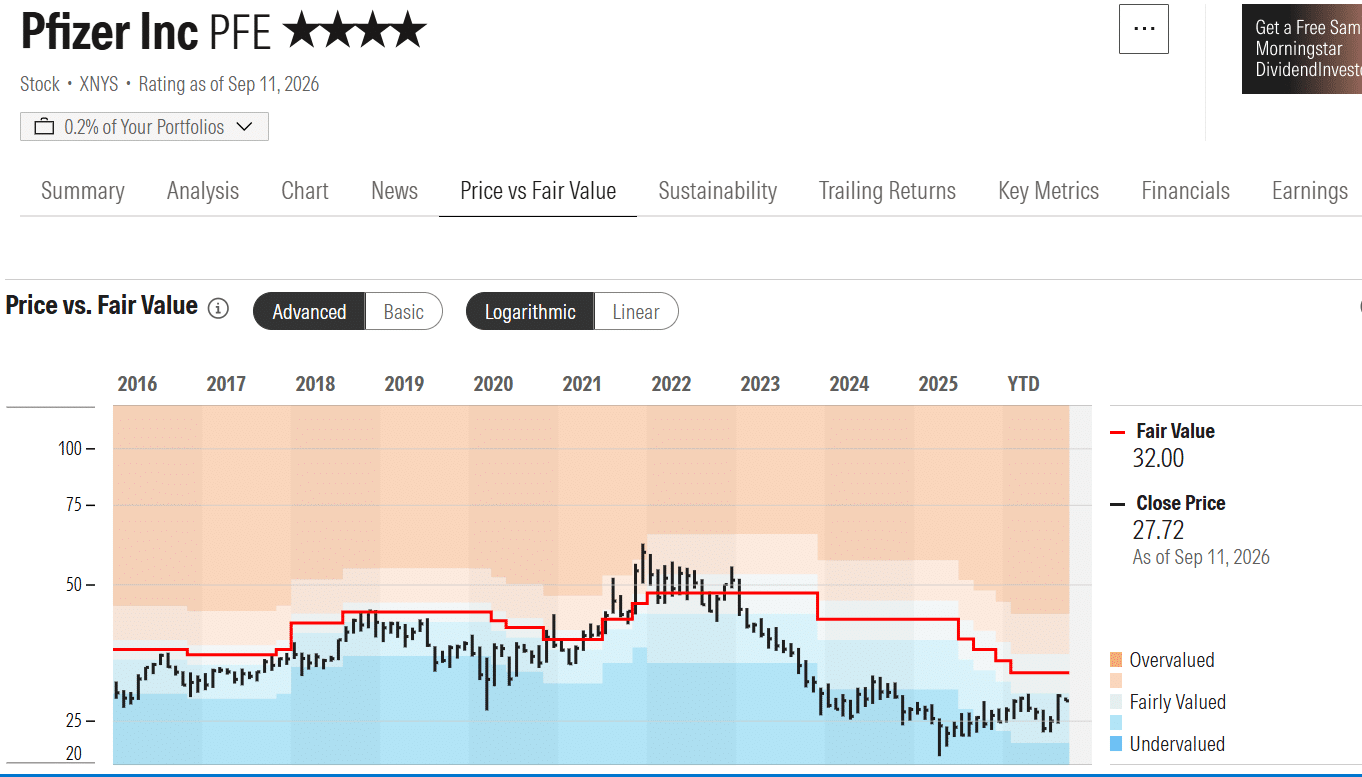
Price vs Fair Value: Stock investors will appreciate this feature. The Price vs. Fair Value chart (above) compares a stock’s historical market price against Morningstar’s calculated intrinsic valuation over time. It visually maps periods when a security traded at a premium or discount, color-coding ranges to show whether an asset was overvalued, fairly valued or undervalued. This allows investors to easily identify potential buying or selling opportunities by evaluating how current trading levels align with long-term fundamental value.
Customizable Screeners & Watchlists: Allows users to filter thousands of stocks, mutual funds, and ETFs using detailed metrics, including fees, Star and Medalist rankings.
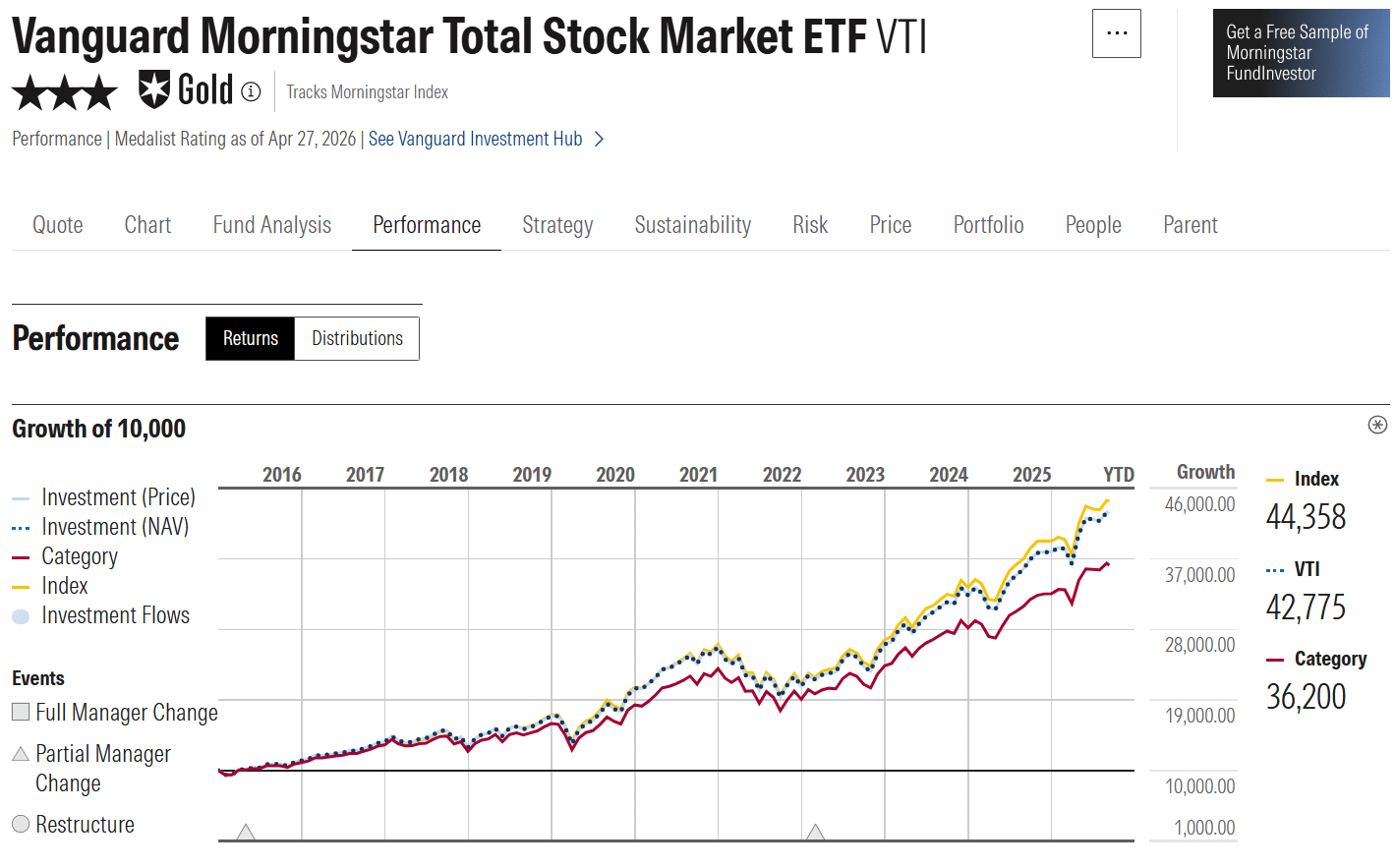
Performance Relative to Category and Index: Fund investors can rely on this Morningstar Investor feature, shown in the image above. The VTI performance, with the blue investment performance line, far surpasses that of the category. You’ll also find the funds annualized returns per various periods and ranking vs peer funds in the Performance section.
Free Trial: You can test-drive the paid tier before committing, which is a low-risk way to see if the tools fit your investing style. Plus $50 discount for first year subscription.
Morningstar Cons – What Gave Us Pause
It’s built for fund and stock investors, not day traders: If you’re looking for real-time charting, technical indicators, or short-term trading signals, Morningstar isn’t your platform. It’s designed for fundamental, long-term analysis — think buy-and-hold investors and people building a retirement portfolio, not active traders.
The learning curve: Morningstar’s interface is data-dense. If you’re a brand-new investor who doesn’t yet know the difference between an expense ratio and a P/E ratio, the platform can feel overwhelming before it feels useful. But, Morningstar educational materials can help users to understand the platform and investment metrics.
Price relative to free alternatives: Many brokerages now offer free screeners, research, and portfolio tools that cover a good chunk of what Morningstar charges for. Before subscribing, it’s worth checking what’s already available through your existing brokerage account. Although, if you’re considering paying an advisor one percent AUM to manage your portfolio, or subscribing to Morningstar and self-managing your investments, then Morningstar Investor is a bargain.
Who Should Actually Pay for Morningstar?
Morningstar Investor is worth it for:
- Long-Term Fundamental Stock Pickers: Value-oriented investors who prioritize intrinsic valuation, economic moats, balance sheet health, and in-depth equity analyst research over short-term technical indicators.
- Active Mutual Fund & ETF Investors: Self-directed investors looking for forward-looking Medalist Ratings, expense analysis, and qualitative pillar evaluations (People, Process, Parent) to select top-performing funds.
- Multi-Account DIY Portfolio Managers: Investors with complex portfolios across multiple retirement and taxable accounts who use tools like Portfolio X-Ray to detect underlying stock overlaps, style drifts, and sector concentration risks. Finding lower cost funds for existing holdings is easy, with Morningstar.
- Savers & Pre-Retirees with Substantial Portfolios: Experienced investors with larger portfolios (typically $50,000+) who need deep data diagnostics to optimize asset allocation and minimize drag from hidden fund fees.
It’s probably not worth it if you have a small, simple, low-cost index fund portfolio, are just starting out or are primarily interested in active/technical trading strategies. The Morningstar free tier offers basic fund overview pages, basic star ratings, limited articles, and snapshot data.
How Much Does Morningstar Investor Cost?
Morningstar Investor runs $249 for a full year (without the $50 discount), which breaks down to roughly $20.75 per month. Whether that’s worth it really comes down to two things: how much money you’re managing and how often you’ll actually use the platform.
Morningstar Investor pricing at a glance:
| Plan | Price | Details |
|---|---|---|
| Annual plan | $249/year | The best deal of the three options |
| Monthly plan | $34.95/month | Costs roughly 68% more over a year than paying annually |
| Discounted first year | ~$199/year | Click on this link to get $50 off your first year |
| Trial period | 7 days | Full feature access; cancel before it converts to a paid plan |
Does the price make sense for your portfolio?
The subscription fee matters a lot less as your account balance grows:
- A $50,000 portfolio: $249 works out to 0.5% annually
- A $100,000 portfolio: that drops to 0.25% annually
- A $250,000 portfolio: it’s down to just 0.1% annually
With a $100,000 portfolio, a self directed investor pays 0.25% of assets under management. This is roughly the cost of a robo-advisor portfolio like Wealthfront or Betterment. But, as your portfolio grows, the cost becomes a nominal portion of your portfolio and the subscription will likely optimize your portfolio management.
Morningstar Alternatives – Free Stock Research Tools
If you’re worried about the Morningstar cost, here is a list of free Morningstar alternatives. Although, none have the proprietary Morningstar ranks and Gold, Bronze and Silver features. I’ve checked out Stock Rover in depth and really like it (I’m an affiliate for the company). I’m less familiar with the others. Give them a look and you might be satisfied with a lower cost alternative.
Consider the tools at your brokerage accounts such as Schwab, E*TRADE, Vanguard and Fidelity. I’ve used Fidelity for deep research into individual stocks, as they have a broad range of analyst reports.
Stock Rover – Strong pick if portfolio tracking + screening is your priority. Combines fundamental/technical screening with portfolio analytics and broker integration. Visit the FREE (14-day trial) Stock Rover.
Stock Analysis (stockanalysis.com) – You’ll need to provide your email to review the free options. Stock Analysis offers data and information for fundamental and technical investors including screeners, comparisons, financial statements, analyst estimates, dividend data, and IPO tracking. Great if you want clean fundamentals without noise.
TIKR – Free tier gives you institutional-style financial data (historical statements, estimates, ownership/insider data) with U.S. asset coverage. A lot of serious retail investors have shifted here. To get the full value, you’ll need to purchase a premium tier.
Koyfin – Best if you want Bloomberg-terminal-style charting and screening without paying for it. The free tier is more limited and only includes 2 years of historical data. But the interface and multi-asset dashboards are excellent.
Simply Wall St – With a decent “free” tier, you’ll access up to five company reports per month, visual analysis, community narratives and global market stock coverage. You can create one portfolio with a maximum of 10 stocks. The discovery section delivers screeners and investment ideas.
One honest caveat: none of these fully replicate Morningstar’s actual analyst reports and fund/ETF ratings. For simple stock research and screening though, the free tiers above and most brokerage accounts cover the basics. But for serious long-term investors, Morningstar is tough to beat.
Is Morningstar Investor Worth It? The Bottom Line
Morningstar offers a consistent, data-driven way to evaluate what you own and why. The platform is superb for uncovering investment ideas and comparing existing holdings. The “best of lists” give you a head start on uncovering the premier investments, for your portfolio. Hands-on investors, managing a multi-fund (or stock) portfolio, get all the tools they need to meet their investment goals.
Morningstar Investor helps you navigate mutual funds and ETFs with confidence. Get independent ratings, analyst picks, and in-depth research across thousands of investment options. Compare performance, risk, fees, and sustainability metrics side by side. Use powerful tools like Fund Compare and watchlists to streamline your strategy. Whether building a portfolio or evaluating your 401(k), Morningstar gives you the clarity you need. Try it free and unlock smarter investing today.
Start your Morningstar Investor free trial – explore top funds & ETFs now!If you want to see the platform in action, including a walkthrough of the tools discussed above, check out the full video review linked at the top of this post. And as always, treat any research tool — Morningstar included — as one input into your investing decisions, not the final word.
Start your Morningstar Investor free trial – unlock portfolio insights now!Related
Disclosure: Please note that this article may contain affiliate links which means that – at zero cost to you – I might earn a commission if you sign up or buy through the affiliate link. That said, I never recommend anything I don’t believe is valuable.
