
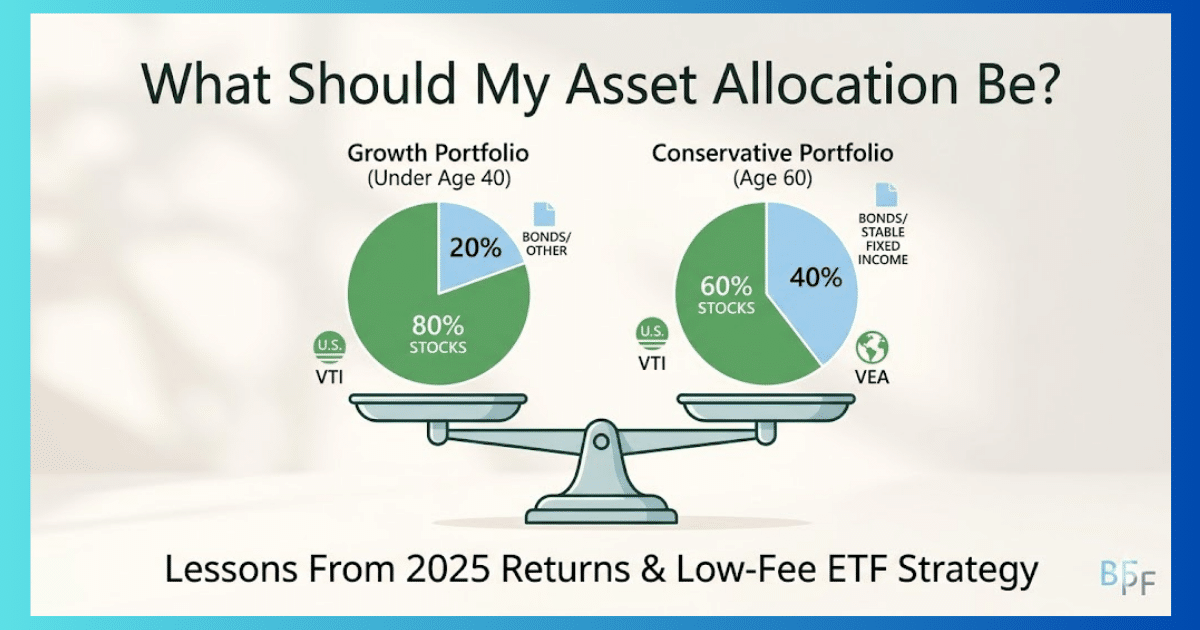
Wondering, “What should my asset allocation be?” The 2025 market performance data can inform sensible asset allocation ETF portfolios.
Key Points:
- The Recency Bias Trap: It’s easy to chase the latest high-performing assets, but recent winners rarely remain at the top indefinitely.
- The Power of Reversals: After years of underperforming US markets, developed international stocks (VEA) surged by 35.2% in 2025—proving why you shouldn’t drop an asset class just because it had a few quiet years.
- Consistency in Bonds: While 3-year bond returns hover at 4.3% annualized , they nearly doubled to 7.1% last year, underscoring their role in stabilizing a portfolio.
- The Low-Fee Solution: Because predicting year-to-year winners is nearly impossible, the most reliable way to maximize long-term returns is by building your core asset allocation around low-fee, total-market ETFs.
This article may contain affiliate links which means that – at zero cost to you – I might earn a commission if you sign up or buy through the affiliate link.
While it’s easy to get caught up in the year-to-year drama of the stock market, historical data proves that a steady hand beats a chasing strategy every time. Let’s look at the foundational principles of Asset Allocation 101 to see how this plays out in the real world.
If you need help with your investments, we’ve partnered with WiserAdvisor to provide you with access to three vetted Financial Advisors – in your area. Click the image below to sign up. (no obligation when signing up)

10 Year Asset Class Returns
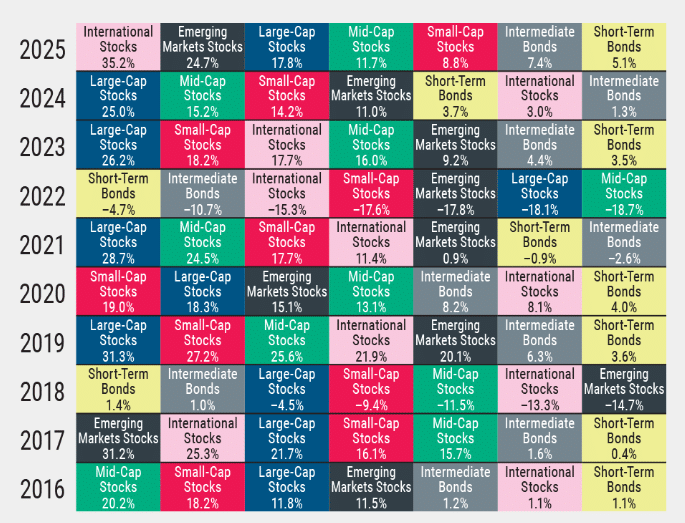
Source: AAII.com
Investing 101
Most investors understand that diversification can temper the volatility of your investment portfolio, smoothing out the losses, and gains. Yet, it can be difficult to diversify when you’re watching the best-performing stocks dominate the US investment market growth. Younger investors might be tempted to hop on the winners, and assume they have the recipe for investment success. And, in some cases, that can be true – but only for the shorter-term.
But, for the rest of us, who lack perfect luck, stock and asset picking genius, and perfect timing, there’s another way to investment success.
Similar to Ecclesiastes 3: “To every thing there is a season, and a time to every purpose under heaven…” every investment asset has its time to shine.
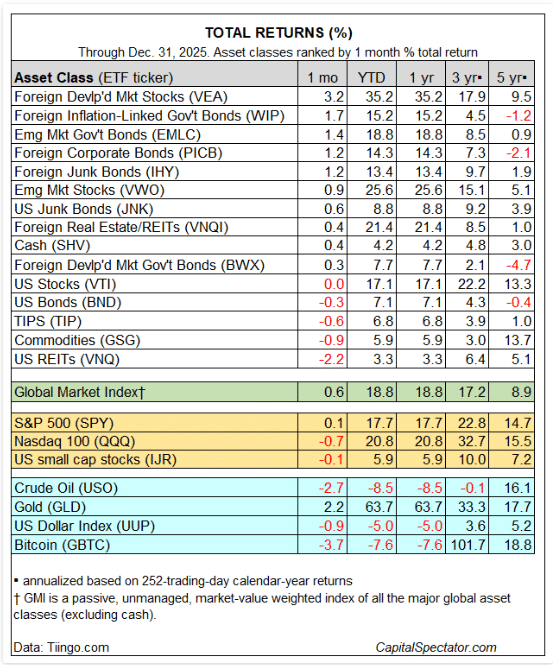
Developed market international stocks returned 35.2% in 2025, tripling its 5-year average of 9.5% and delivering the highest return in 19 years. During the previous 3 to 5 years, international stocks were largely underperforming US Stocks (VTI was at 22.2% for the 3-year, while VEA was at 17.9%). This is the ultimate textbook example of why we don’t drop an asset class just because it had a few quiet years. If you avoided investing internationally due to recent moderate returns, you would have missed out on superior growth in 2025.
If you need help with your investments, we’ve partnered with WiserAdvisor to provide you with access to three vetted Financial Advisors – in your area. Click the image below to sign up. (no obligation when signing up)
While Bitcoin fell -7.6% in 2025, well below it’s 101.7% annualized 3 year gain. If you only invested in crypto, your 2025 Bitcoin allocation would have faltered.
Mid-cap and small-cap US stocks were in the top 29% during three and four of the last 10 years, respectively. And overall, bonds delivered lackluster returns as interest rates hovered in the low single digits, except in 2018 and 2022, when they were the top performing asset class.
It is tough to predict the winners for each year, but there is another way to minimize losses. Make sure that your asset allocation ETF portfolios, own funds with the lowest management fees. Building your core portfolio around low-fee, total-market ETFs—like Vanguard’s VTI for US stocks or VEA for developed international markets—ensures you capture these shifting market wins without sacrificing your returns to high management costs.
Asset Class Returns Last Year and Beyond
Source: CapitalSpectator.com
Recency bias, a behavioral finance term describing the impact that recent events have on our beliefs and performance. We remember what happened recently and expect it to continue in the future. But, as these investment return charts show, recent asset class returns don’t necessarily predict future investment returns.
Notice the difference between last years winner’s, and their 5- and 3-year averages. Three year US bond returns were 4.3%, while last years performance was nearly double at 7.1%. 2025 was an outstanding year overall, in the financial markets. Unfortunately, those stellar returns are unlikely to persist.
If you need help with your investments, we’ve partnered with WiserAdvisor to provide you with access to three vetted Financial Advisors – in your area. Click the image below to sign up. (no obligation when signing up)
When comparing the 5-year average asset class returns with last year’s performance, most of the lower performing assets in the 5-year average, were winners last year. The only asset classes that underperformed their 5-year averages in 2025 were commodities, REITs and Bitcoin. This data gives even more credence to the difficulty in accurately predicting investment performance.
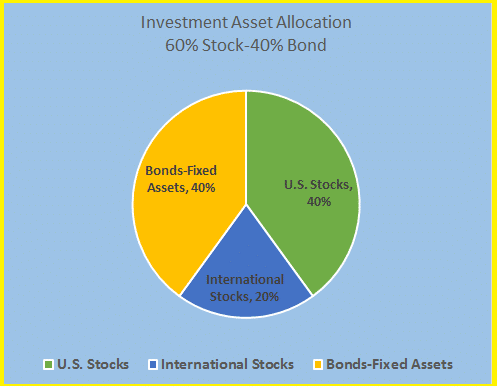
What Should my Asset Allocation be? Key Guidelines
Asset allocation refers to the percentage division of various asset classes within your investment portfolio. In the broadest sense, it is stated as a ratio of stocks to bonds. For example, a younger person, under age 40 might consider owning 80% stocks, 15% bonds or fixed income, and 5% other, which might include crypto, metals or alternative assets.
Conversely, a 60-year-old retiree, with her earning years behind, might prefer a conservative asset allocation with 60% invested in riskier stock investments and 40% in fixed income.
The asset allocation theory is built on a simple reality (based upon 100+ years of historical returns) that long term stocks earn higher average annual returns, but suffer more dramatic price swings, and greater losses. Fixed-income assets, on the other hand, offer much less volatile price movements but deliver lower average annual returns.
The diverse categories of stocks, bonds and alternative asset classes can be used to craft your own personal investment portfolio.
If you need help with your investments, we’ve partnered with WiserAdvisor to provide you with access to three vetted Financial Advisors – in your area. Click the image below to sign up. (no obligation when signing up)
Your personal asset allocation can be as simple as three to four core stock and bond ETFs, or it can expand to include up to ten distinct asset sub-classes. The exact percentages you assign to each stock, bond or alternative ETF will depend predominantly on your individual risk tolerance and age.
Ultimately, the goal of a diversified asset allocation is to reduce overall portfolio volatility by owning a mix of less-correlated assets, paving the way for more stable, long-term returns.
Check out the “Related” links below for more details on how to craft your own asset allocation.
Final Thoughts: Choosing Your Ideal Asset Allocation and Diversification Strategy
When you find yourself wondering, “What should my asset allocation be?” remember that history is a powerful guide. Chasing last year’s winners is a fast track to underperformance, while a commitment to true investment portfolio diversification protects your wealth from the market’s unpredictable mood swings. By letting go of recency bias and building a balanced, low-fee ETF foundation, you ensure that your portfolio is always positioned to capture the next wave of market growth—wherever it happens to strike.
Review some of our other articles which delve into the specifics of designing an asset allocation suitable for you.
Related Articles
- Best Asset Allocation Based On Age & Risk Tolerance
- What Is An ETF – And Why Are They The Easiest Way To Invest?
- Strategic vs Tactical vs Dynamic Asset Allocation
- Lazy Investors Asset Allocation Guide to Amass $787, 355
- Rebalance Your Asset Allocation Guide and Best Portfolio Rebalancing Strategies
- Why is Asset Allocation Important? The Most Crucial Investment Concept
If you need help with your investments, we’ve partnered with WiserAdvisor to provide you with access to three vetted Financial Advisors – in your area. Click the image below to sign up. (no obligation when signing up)
Disclosure: Please note that this article may contain affiliate links which means that – at zero cost to you – I might earn a commission if you sign up or buy through the affiliate link. That said, I never recommend anything I don’t believe is valuable.
